

Kickstage
Web products for clients180
TiB on Ceph
RBD/
storage type
5
years with Hostzero
Hostzero takes care of everything below our applications, including storage. It just works, so we don’t have to think about it.
Ljubo Radoš
Kickstage
S3 Exit • Open-Source Enterprise Storage
S3-compatible object, block and file storage on dedicated clusters — planned, built and operated 24/7, in our Frankfurt data center or on your hardware. The sovereign alternative to AWS S3, with pricing that does not grow with every gigabyte you move.
2021
Running Ceph in production since
15+
Years open source
24/7
Ceph operations on call
250 €/h
Emergency support
0 data lost
Managed Ceph means you use Ceph storage and we run it. We plan and build the cluster, then handle monitoring, updates, security patches, capacity and incidents, 24/7. You keep the data, the keys and the right to leave at any time. The cluster runs in our Frankfurt data center or on your hardware.
Still on Squid or older? Your Ceph release no longer gets fixes.
We upgrade clusters to Tentacle, including clusters we did not build.
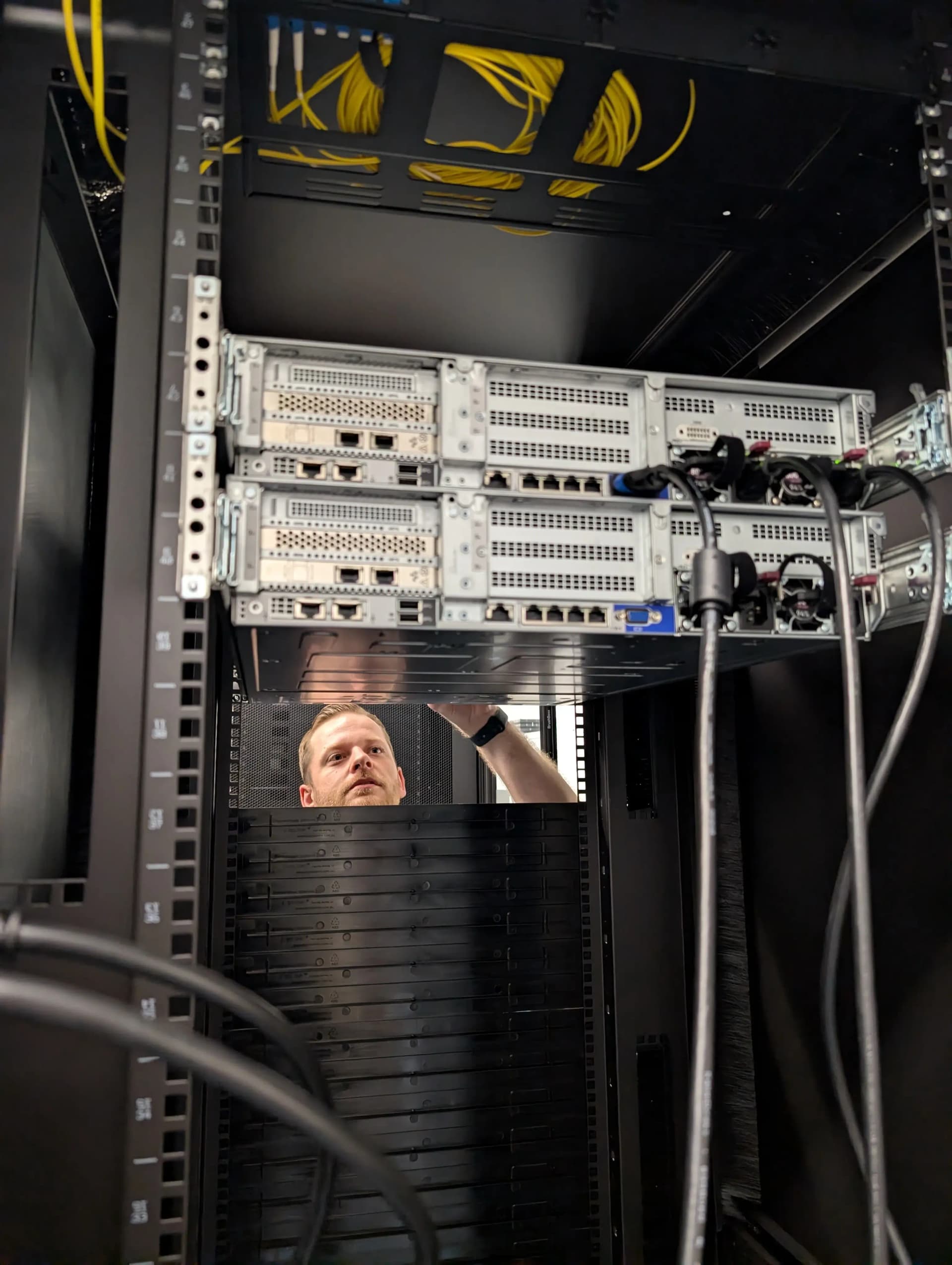
Initial situation
Storing data in S3 is the cheap line on the invoice — egress and API requests are the expensive ones. 15 TB stored plus 200 TB of egress comes to €268,140 per year on AWS S3 (as of 2026), and the data sits under US jurisdiction either way. Ceph turns that equation around: open-source software with no license fees, running on dedicated hardware in Frankfurt or on your premises — where throughput is your own network, not a billable event.
The offer
We plan, build and run your cluster
Updates & security patches handled
24/7 monitoring & emergency response
On-premise, Frankfurt DC or hybrid
No lock-in — open source, export anytime
Feed high-performance GPUs and AI pipelines with massive parallel throughput. From block storage (RBD) to S3 object storage — scale from terabytes to exabytes without changing architecture or vendor.
Native immutability, object locking and snapshots protect your critical assets. When backups are the last line of defense, storage that cannot be silently encrypted is your recovery-first insurance.
Independent of hyperscalers and external providers. Your data under German law, on infrastructure you control — with open standards that keep every exit open.
Fully managed
We provide the hardware and run the cluster 24/7
From €500/month
Expert support
Your team runs Ceph on our hardware, our engineers are on call
€150/hour
24/7
Emergency only
For the clusters we maintain
Free
Fully managed
We run your cluster remotely, 24/7
From €500/month
Expert support
Your team runs Ceph, we review, plan upgrades and step in
€150/hour
Business hours
Emergency only
For clusters we maintain
Free
Service models
Every cluster is sized individually — typical projects range widely, and we're happy to talk to businesses of all sizes. All prices are net.
Around-the-clock emergency response and data recovery — also for Ceph clusters we did not build. Degraded clusters, failed OSDs, lost data: we stabilize first, explain later. €250/hour • 24/7 emergency hotline: +49 2932 9398 511 — fixed quote after assessment.
Request offer| Hostzero | You | |
|---|---|---|
Hardware and network | In our Frankfurt data center: servers, network, power | On your premises: rack space, power, uplink, with our support |
Operating system on Ceph nodes | In our data center: Debian 13, installed and maintained by us | On your premises: OS of your choice |
Security patching | Applied by us | — |
Ceph versions and upgrades | Planned and run by us, including CephX key rotation | — |
24/7 monitoring and alerting | Our on-call engineers | — |
Capacity planning | We plan and add nodes before you run out of space | You share your growth forecast |
Data, buckets and access keys | — | You own and manage them |
| Criterion | AWS S3 | Hostzero Managed Ceph |
|---|---|---|
Cost model | Per-GB storage + egress + per-request fees | Fixed monthly price for the cluster |
Egress | Billed per GB — grows with your usage | Included — it is your network |
Data jurisdiction | US CLOUD Act applies | German law — Frankfurt DC or your premises |
Interfaces | Object storage (S3 API) | Object (S3-compatible) + block (RBD) + file (CephFS) |
Elastic capacity | Instant, effectively unlimited | Planned capacity; hardware scales in days, not minutes |
Durability & replication | Multi-region replication managed for you | Replication / erasure coding designed with you — your responsibility, our job |
Ecosystem | Deep AWS integrations (Lambda, Athena, CloudFront) | Open-source stack (Proxmox, Kubernetes, Prometheus) |
Lock-in | Egress pricing makes leaving expensive | Open standards — take your data anywhere |
Support | Ticket tiers, paid support plans | Direct engineer access |
Architecture
S3-compatible API — s3cmd, rclone, AWS SDKs and backup tools keep working
Virtual disks for Proxmox, Kubernetes (CSI) and OpenStack — with snapshots and cloning
POSIX-compliant shared filesystem for legacy workloads and shared data
Automatic re-replication on disk or node failure — no RAID rebuild windows
Replication or erasure coding per pool
Object lock & immutable snapshots
Prometheus/Grafana monitoring & alerting
Multi-site replication where required
RBD block storage with snapshots and live migration.
Persistent volumes via ceph-csi, isolated per tenant.
Which S3 exit fits?
Pure S3 object storage at the lowest cost — 0.03 €/GB/month. The right call when object storage is all you need and simplicity beats features. RustFS itself is a young project — we say so openly on its page. →
When you also need block or file storage, VM disks under Proxmox or Kubernetes, self-healing at petabyte scale, or a storage layer with well over a decade of production maturity behind it — Ceph is the answer.
Onboarding
Storage inventory, workloads, growth and compliance — and whether Ceph is the right fit at all
Architecture, hardware, network — cluster built and load-tested, on-premise or in Frankfurt
Data moves bucket by bucket, volume by volume — your current storage stays as fallback
Monitoring, patching, capacity management — per your service model, up to 24/7 with SLA
Upstream. We run the official open-source Ceph releases, not a fork of our own, so your cluster never depends on us for updates or features.
Yes. You keep full access to your cluster, your data and your access keys. We agree up front how changes are coordinated, so nobody works against each other.
Your data stays yours. Ceph is open source with an S3-compatible API, so you can move your data or take over operations yourself, and we help with the handover.
Around the clock. Critical incidents reach an engineer through our 24/7 emergency hotline, +49 2932 9398 511. The exact response times are set in your service agreement.
Supported upstream releases. We upgrade clusters before a release reaches end of life: Ceph Squid (19.2) reaches its estimated end of life on 31 October 2026, and we move clusters to Tentacle, including clusters we did not build.
Yes. We start with an assessment, stabilize what is broken and then take over operations.
Why teams choose Hostzero for storage
We run Ceph in production every day — as the storage backend under the Proxmox and Kubernetes platforms we operate for customers and for ourselves, from Frankfurt.
Enterprise open-source experience — network security on Juniper/Linux, SELinux, and production storage clusters we run for ourselves and our customers.
Ceph is not a side business: it is the layer our own managed platforms stand on. We debug it at 2 a.m. because our infrastructure runs on it too.
No ticket tiers, no middlemen — you talk to the people who run your cluster.
Customer results
180
TiB on Ceph
RBD/
storage type
5
years with Hostzero
Hostzero takes care of everything below our applications, including storage. It just works, so we don’t have to think about it.
Ljubo Radoš
Kickstage
FAQ
Managed Ceph means you use Ceph storage and we run it. We plan and build the cluster, then handle monitoring, updates, security patches, capacity and incidents, 24/7. You keep the data, the keys and the right to leave at any time. The cluster runs in our Frankfurt data center or on your hardware.
Managed Ceph operations start at €500 per month; the final quote depends on cluster size and service level. Cluster planning and setup is priced after a free assessment, and emergency support for clusters we did not build costs €250 per hour. All prices are net.
Yes. You keep full access to your cluster, your data and your access keys. We agree up front how changes are coordinated, so nobody works against each other.
Supported upstream releases. We upgrade clusters before a release reaches end of life: Ceph Squid (19.2) reaches its estimated end of life on 31 October 2026, and we move clusters to Tentacle, including clusters we did not build.
Yes — the RADOS Gateway implements the S3 API, so s3cmd, rclone, AWS SDKs and most backup tools work unchanged. Exotic S3 features can have edge cases — we check your exact toolchain during the assessment.
If your egress is minimal, your data may legally live under US jurisdiction, and you rely on deep AWS integrations like Lambda triggers, Athena or CloudFront — S3 remains a reasonable choice. The math flips as data volume and egress grow.
Pure S3 object storage at modest scale: our Managed RustFS is cheaper and simpler. Block, file and object together, VM storage, or petabyte scale: Ceph. Where MinIO fits into this picture — the full comparison is in our Ceph vs MinIO article.
Both. We plan, build and operate clusters on your hardware, in our Frankfurt data center, or hybrid — the operating work is the same, the jurisdiction stays German either way.
Yes — 24/7 emergency support and data recovery are available for Ceph clusters we did not build. We stabilize the cluster first and talk about ongoing operations later, if at all.
Anytime. Open source, open standards, S3-compatible API — your data is portable by design, and we will help you move it. Exit-readiness is the product.
From our engineering blog
8 min read
MinIO's new license changes the calculus. Why Ceph is the open-source object storage alternative teams are migrating to in 2026.
11 min read
One Ceph cluster, many Kubernetes tenants: the CephX cap set, RADOS namespaces and mgr grants that stop cross-tenant CephFS access — and the ISO 27001 evidence.
11 min read
Five kernel settings that make the difference between mediocre and outstanding Ceph performance in 2026 — and why the defaults are the wrong choice for storage clusters.
Start now
Talk to an engineer — 30 minutes, no sales pitch. Tell us your data volumes and workloads, and we will tell you honestly whether Ceph fits — or whether staying on S3, or the lighter RustFS, is the right call for you.