

S3 Exit • MinIO Successor
Managed RustFS
Production-grade RustFS hosting in Frankfurt, Germany.
We run RustFS 1.0 for you: S3-compatible, usage-based pricing, 24/7 operations. You get the MinIO successor in production without building your own storage ops team.
S3-compatible API
Frankfurt, Germany
0.03 €/GB/month
24/7 managed operations
No vendor lock-in
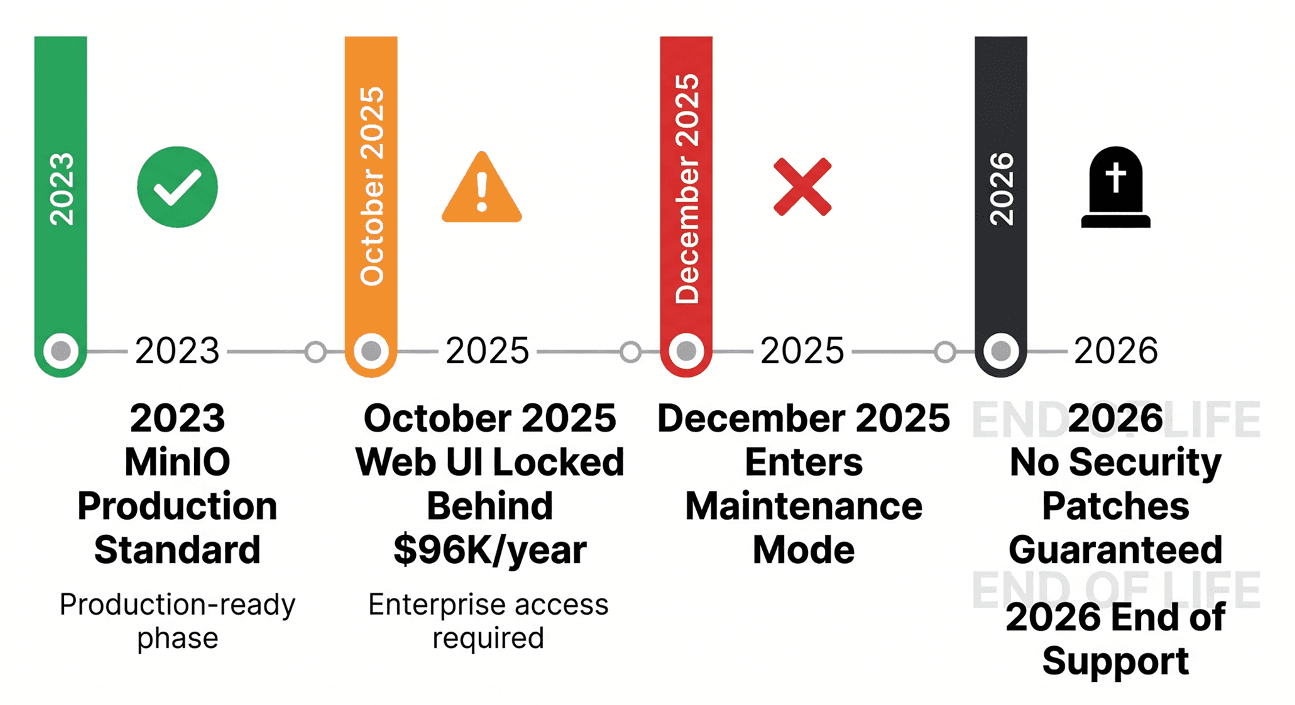
MinIO timeline
Initial situation
MinIO is in maintenance mode. S3 keeps getting more expensive
In December 2025, MinIO Inc. stopped active development of the open-source version. Running MinIO today means running legacy software. Staying on S3 means unpredictable egress bills and US jurisdiction over your data. RustFS, the open-source MinIO successor, fixes both. Since version 1.0 (16 September 2026), its core S3 engine is GA and production-ready.
- Same S3 API as MinIO: your applications keep working without code changes
- 2.3x faster than MinIO on small objects
- Apache 2.0 licensed — no AGPL surprises
- GA since September 2026, still a young project: which is exactly why managed operations matter
The offer
What Managed RustFS
means at Hostzero
We run the cluster 24/7
Security patches applied immediately
99.9% availability SLA
Backups + disaster recovery included
Your data stays portable
Why RustFS Is the Future of S3-Compatible Storage
Same S3 API, no code changes
Your applications talk to RustFS the way they talked to MinIO: same API, same SDKs. We copy your buckets with checksum verification, run old and new storage in parallel and switch over without downtime. MinIO's on-disk format is still in preview in RustFS, so we migrate by copy, not by swapping the binary.
Predictable Costs
Usage-based pricing at 0.03 €/GB/month. No egress billing, no API-call surprises. A 15 TB workload costs about 5,530 €/year — the same workload on AWS S3 runs 268,000 €/year.
EU Data Sovereignty
Your data lives in our Frankfurt data center, under German law, powered by renewable energy. GDPR compliance you own — not compliance you rent from a hyperscaler.
Transparent pricing
Packages & Prices
All prices are net. One pricing model — no tiers, no egress fees, no surprises.
Managed RustFS
We run RustFS for you — production-grade, fully managed
Proof of Concept
Validate the drop-in replacement before committing
MinIO Exit Assessment
Running MinIO in production? We audit your cluster, map the migration path and give you a fixed quote. Free with any 30-minute consultation.
Audit
From S3 to RustFS in six weeks — zero downtime
Audit
Bucket inventory, access patterns, data classification
Parallel deploy
RustFS runs next to S3, dual-write enabled, production untouched
Cutover
Reads switch to RustFS; S3 stays as read-only fallback for 30 days
Operation
We run it 24/7; you decommission S3 and stop paying egress
RustFS or Ceph? Two ways to exit S3.
Both run in our Frankfurt data center, both speak S3, both end your hyperscaler dependency. RustFS is the lightweight choice for backups, logs and S3 workloads — and the natural path off MinIO. Ceph is the enterprise platform for block, file and object storage at petabyte scale, production-proven for over a decade. Not sure which fits? That’s what the 30-minute call is for.
| Criterion | Managed RustFS | Managed Ceph |
|---|---|---|
Best for | S3 / MinIO replacement, backups, logs | Enterprise storage platform |
Maturity | GA since September 2026 (1.0). Core S3 production-ready, some features in preview | Production-proven since 2012 |
Block & file storage | No — object storage only | Yes (RBD, CephFS) |
MinIO drop-in | Yes, at the API level | No |
RustFS is young. Here’s how we make it safe.
RustFS 1.0 is GA, and the project marks its core S3 engine as production-ready. What it does not have yet is a long production history like Ceph’s. That is the gap a managed service closes.
We carry the operations
We patch security issues immediately, test every new release in staging before it touches your data, and keep preview features off in production until the project marks them stable.
You get a real SLA
99.9% availability, in the contract. Self-hosted, your availability is whatever your ops team can do at 2 a.m.
You’re never locked in
RustFS is Apache 2.0 open source. Take your data and run it yourself anytime — we’ll even help you leave. That’s the point of an exit.
FAQ
Frequently Asked Questions
Is RustFS production-ready?
Yes, for core S3 object storage, since version 1.0.0 (16 September 2026). Two features are still in preview: S3 Tables and MinIO on-disk compatibility. We keep them off in production until the project marks them stable.
Can RustFS replace MinIO?
Yes, at the API level: applications keep working without code changes. Existing data moves by copy, with checksum verification, because reading MinIO data in place is still a preview feature in RustFS.
Is RustFS fully S3-compatible?
It covers the S3 API including versioning, WORM/object locking, encryption and replication. We verify your specific API calls during the proof of concept.
What happens if the RustFS project dies?
Your data is stored behind a standard S3 API and is migratable at any time — to Ceph in the same data center, to any S3-compatible store, or to hardware you own. No proprietary formats, no exit fees.
Where is my data stored?
In our Frankfurt data center, operated under German law and powered by renewable energy. Data never leaves Germany.
How long does migration from S3 take?
Around six weeks for a typical 15 TB setup, with zero downtime: parallel deployment, dual-write, checksum verification, then cutover with a 30-day S3 fallback.
Start now
Ready for your S3 exit?
Talk to an engineer — 30 minutes, no sales pitch. We’ll run the numbers for your workload and tell you honestly whether RustFS, Ceph or staying put is the right call.