
RustFS vs S3 in EU: MinIO Is Dead. Here's Your Escape Route.
MinIO is dead. S3 is expensive and locks you into US infrastructure. RustFS is the S3 replacement you need in 2026—at 15TB, it costs €8.5k/year vs S3's €268k/year. Complete breakdown inside.
Why MinIO Died (And Why This Matters)
MinIO didn't fail because the technology broke. It failed because the company decided to stop investing in the open-source version.
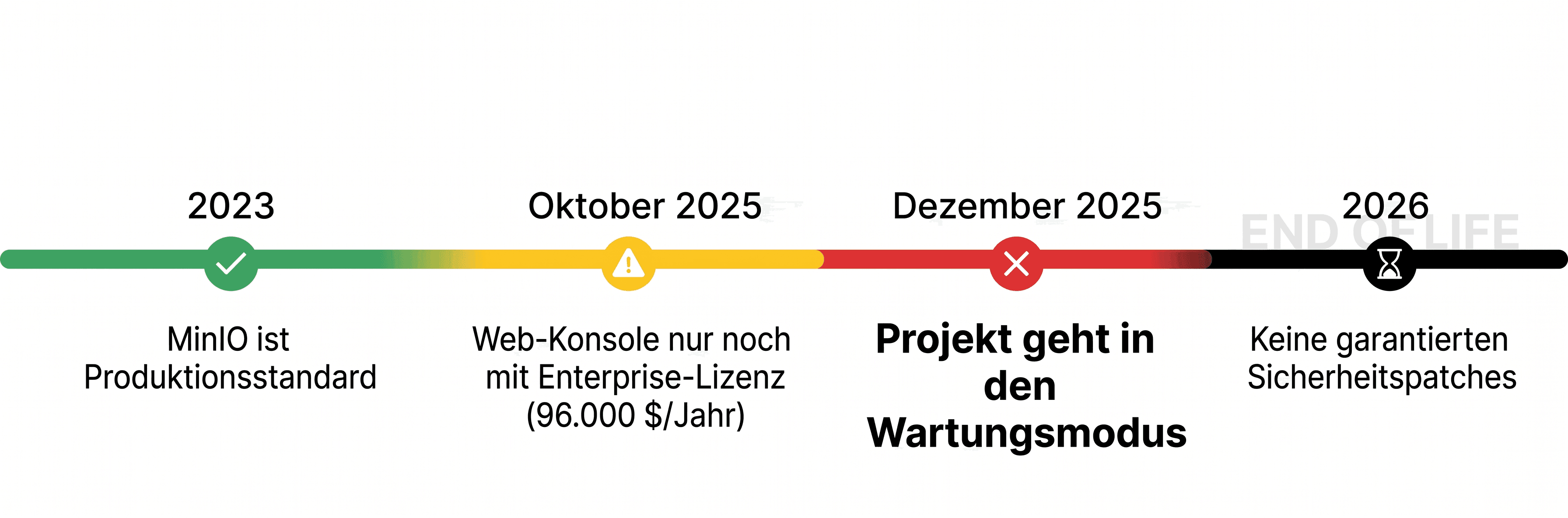
In December 2025, MinIO Inc. made an official announcement: the project was entering "maintenance mode." That's corporate-speak for: "we're not building this anymore, but we won't formally kill it."
What does maintenance mode actually mean?
- No new features (you get security patches, maybe, if they feel like it)
- No PR reviews (community contributions sit in limbo)
- No guaranteed security updates (if a vulnerability is discovered, you're on your own)
Before that, in October 2025, MinIO locked the web console behind a $96,000/year enterprise license. The free version has a limited UI. Suddenly, managing your storage clusters became expensive.
This wasn't an accident. MinIO Inc. made a deliberate choice: push users toward the commercial offering, or push them out.
The result? If you're running MinIO today, you're on legacy software. And if you're planning to migrate from S3 to MinIO in 2026, you're migrating to a dead end.
Why S3 Is Expensive
Everyone complains about S3 pricing. They're right to complain. But they're complaining about the wrong thing.
S3 isn't expensive because AWS is greedy. S3 is expensive because its pricing model is unpredictable. You pay for storage (reasonable). You pay for requests (fine). But then you pay for egress—and here's where it compounds: that €0.09 per GB of data leaving AWS adds up in ways you didn't anticipate.
Store 15 TB. Transfer 200 TB per month (typical for B2B SaaS backups). Here's what happens:
Storage: 15 TB × €0.023/GB-month = €345
Egress: 200 TB × €0.09/GB = €18,000
API calls: 10M requests × €0.0004 = €4,000
---
MONTHLY: €22,345
YEARLY: €268,140
By year three, that bill is €370,000. You didn't add workloads. AWS just found new ways to charge you.
The second problem is sovereignty. Your data lives in US infrastructure, governed by US law. You say "we're GDPR compliant" because AWS says so. But you don't control the data center. You don't control the region. You don't control the exit path. You're renting compliance, not owning it.
Neither of these problems is catastrophic for small teams. But they compound.
RustFS: The MinIO Replacement That Actually Works
RustFS is a new object storage server written in Rust. It speaks the S3 API. It can hold your data the same way S3 does. And here's the killer feature: it can literally replace MinIO in your infrastructure without changing a single line of code.
Drop-in binary replacement. You can:
- Stop your MinIO server
- Replace the binary with RustFS
- Start it up
- Your data, buckets, and configurations stay intact
No migration scripts. No data copying. No downtime.
Performance:
- 2.3x faster than MinIO for small object payloads (4KB—typical for backups, logs, metadata)
- Full S3 compatibility (versioning, WORM compliance, encryption, replication)
- Entire binary is under 100MB (runs on ARM, VPS, data centers)
- Apache 2.0 licensed (no AGPL surprises)
The catch: RustFS is in alpha. The official documentation explicitly says "do NOT use in production environments." The project is only 18 months old. It's mature for a research project, but it's not battle-tested at scale like SeaweedFS (which has been production-ready since 2015).
So why talk about it?
Because RustFS represents the future. MinIO is dead. SeaweedFS is production-ready but was built for different priorities (billions of small files, not backup scenarios). And Garage is too niche (geo-distributed homelab storage, AGPL licensing).
RustFS fills the gap: it's the spiritual successor to MinIO, built for the same use case (S3 replacement), but better designed and actually maintained.
Timeline reality:
- 2026: RustFS is still alpha. Don't run it in production. Use it in staging. Test it.
- 2027: RustFS likely hits stable release. Migration from MinIO becomes trivial.
- 2028: RustFS becomes the de facto MinIO replacement.
If you're on S3 today and hate the costs, your options are:
- Wait for RustFS (free, but risky, no managed support)
- Switch to SeaweedFS now (mature, production-ready, different architecture)
- Use managed RustFS (pay for ops, get stability + support while RustFS matures)
The Real Numbers: TCO Comparison
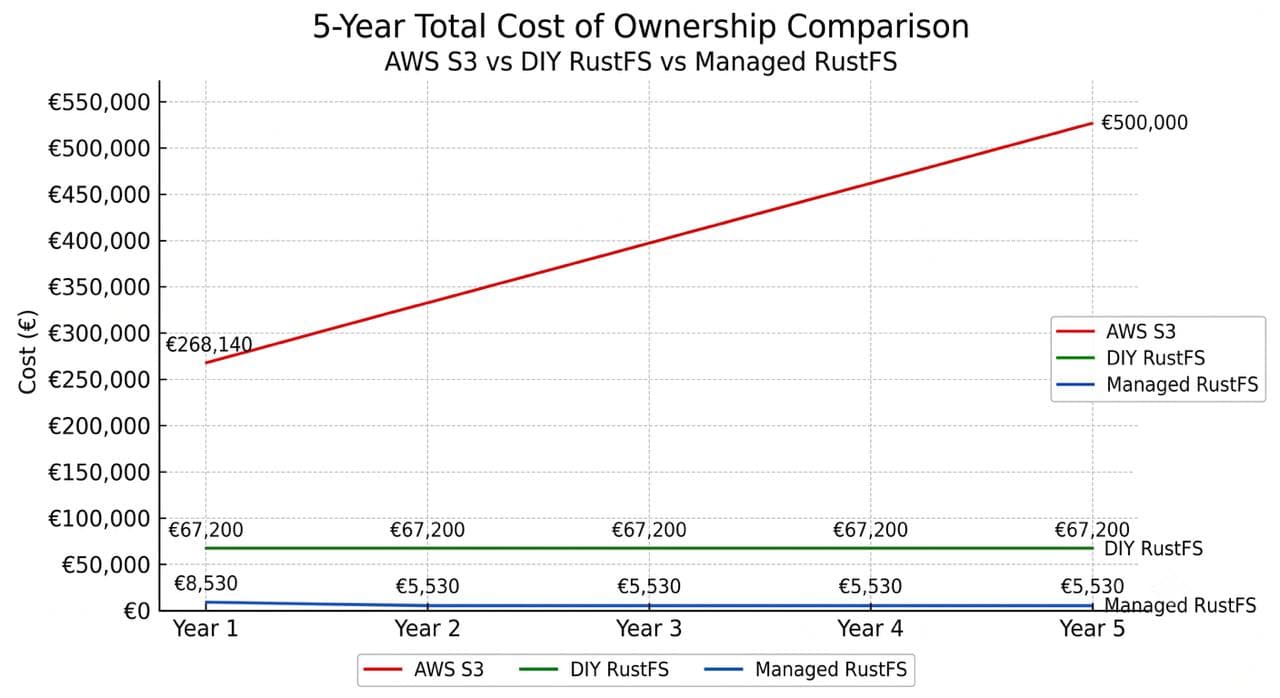
Scenario: German SaaS company, 15 TB stored, 200 TB monthly egress (typical B2B SaaS backup scenario)
AWS S3 (2026 pricing)
Storage: 15 TB × €0.023/GB-month = €345
Egress: 200 TB × €0.09/GB = €18,000
API calls: 10M requests × €0.0004 = €4,000
---
MONTHLY: €22,345
YEARLY: €268,140
RustFS Self-Hosted (DIY)
Infrastructure: €7,200/year
DevOps salary (1 FTE): €60,000/year
---
YEARLY: €67,200
But there's a catch: You're hiring a full-time DevOps engineer just to run RustFS. If you self-host, you're:
- Betting on alpha software in production
- Responsible for security patches
- On the hook if something breaks at 2am
RustFS Managed (Hostzero)
Usage-based pricing: €0.03/GB/month
One-time setup fee: €3,000
For 15 TB scenario:
15,360 GB × €0.03/month × 12 months = €5,529.60/year
---
FIRST YEAR: €8,529.60 (€5,529.60 + €3,000 setup)
YEARS 2+: €5,529.60/year
Includes: ops, support, security patches, monitoring, backups, SLA 99.9%, 24/7 response.
Your data is yours: zero lock-in, full autonomy, migrate anytime.
Why Managed is Actually Cheaper:
DIY requires hiring a full DevOps engineer (€60k/year).
Managed RustFS costs €5.5k/year for the same infrastructure + professional ops.
What you get:
- 24/7 support (we absorb alpha software risk)
- Security patches (immediate response)
- SLA 99.9% uptime guarantee
- Your data stays yours (zero lock-in, full autonomy, migrate anytime)
- Your team focuses on product, not ops
The Numbers Over Time
Year | S3 | DIY RustFS | Managed RustFS |
1 | €268k | €67k | €8.5k |
2 | €295k | €67k | €5.5k |
3 | €370k | €67k | €5.5k |
4 | €430k | €67k | €5.5k |
5 | €500k+ | €67k | €5.5k |
TOTAL | €1.86M | €335k | €30.5k |
|---|
The math is brutal. At 15TB, Managed RustFS is 57x cheaper than S3 in year one.
DIY is cheaper than managed in the first year (€67k vs €8.5k), but you need to hire a full DevOps engineer.
By year two, managed is 53x cheaper than S3, and you haven't spent a dime on hiring.
Migration Path: From S3 to RustFS (The Realistic Timeline)
Total time: 6 weeks. Downtime: Zero (if done correctly).
Week 1-2: Planning
- Audit your S3 buckets (total size, request patterns, data sensitivity)
- Classify your data (which stays hot, what's archive)
- Plan your RustFS infrastructure (how many nodes, where physically)
- File GDPR verification request if needed (Hostzero handles this)
Week 3-5: Migration
- Deploy RustFS in parallel to S3 (don't touch production yet)
- Enable dual-write: new data goes to both S3 and RustFS simultaneously
- Copy existing data over a dedicated network link (~2 weeks for 15TB on Hetzner connection)
- Test your application against RustFS endpoints (make sure S3 API calls work)
- Run checksums to verify data integrity (crucial step, don't skip)
Week 6: Cutover
- Switch application reads to RustFS
- Keep S3 as read-only fallback for 30 days (safety net)
- Monitor RustFS performance (it will be faster—lower latency to Frankfurt)
- Decomission S3 after 30 days
Decision Framework: When to Migrate, When to Wait
Migrate to RustFS NOW if:
- Your AWS bill exceeded €200k/year (math is obvious)
- You have EU data residency requirements (GDPR strict interpretation)
- You want an exit strategy from AWS ecosystem lock-in
- You're currently on MinIO and need a migration path (DIY or managed)
Wait for RustFS to hit stable (2027) if:
- You're currently on MinIO (don't jump twice; wait for stable RustFS, then migrate once)
- You have less than 10TB (cost advantage disappears)
- You need production stability today (use SeaweedFS instead; it's battle-tested)
- Your team lacks DevOps expertise and managed support isn't in budget
Stay on S3 if:
- You're storing less than 5TB and growing slowly (cost difference is immaterial)
- You need AWS ecosystem integration (Lambda, Glue, SageMaker, etc.)
- You value "set and forget" simplicity over cost optimization
- Your compliance requirements don't demand EU data residency
The Real Talk: Should You Use RustFS in 2026?
Not in production.
RustFS is alpha. Use it for:
- Staging environments (test the migration path before committing)
- Development clusters (get familiar with the technology)
- Proof-of-concept migrations (validate that drop-in replacement works for your setup)
But don't bet your production data on alpha software. Your options are:
- Stay on S3 and plan for 2027 (when RustFS likely hits stable release)
- Use SeaweedFS now (it's production-ready, mature since 2015, proven in projects like Kubeflow)
Use managed RustFS (pay Hostzero to absorb the alpha risk, get 24/7 support, SLA)
Why Managed RustFS Matters
The gap between "free but risky" (DIY RustFS) and "stable but expensive" (S3) is real. Managed RustFS closes that gap.
Here's what changes when you use managed:
- We absorb the risk — If RustFS has a security issue, we patch it immediately. You don't.
- We do the ops — Your team builds product. We manage infrastructure.
- You get an SLA — 99.9% uptime guarantee. With DIY, you get whatever your contractor can deliver.
- You're never locked in — Your data is portable. Take it and run RustFS yourself anytime. No lock-in.
For €96k/year, you get:
- Frankfurt data center (GDPR native, low latency, renewable energy)
- 24/7 support (actual humans, not chatbots)
- Monitoring + alerting (you see your data, we see everything)
- Backups + disaster recovery (tested and ready)
- Security patches (applied immediately)
- Migration support (we handle the data movement)
The Bottom Line
MinIO is dead. It's not coming back. MinIO Inc. made a business decision, and now they're pushing users out.
Your options:
- Stay on S3 and accept the cost (€268k/year is just the starting point)
- Move to SeaweedFS now (mature, proven, but different architecture)
- Wait for RustFS to mature (better, faster, S3-compatible, but 12+ months away)
- Use managed RustFS today (get the future now, with support + SLA while you wait for RustFS to stabilize)
If you've been on MinIO for years, or planning to migrate from S3, the answer is clear: RustFS is the future. But RustFS with managed support is the smart move in 2026.
Ready to Escape S3?
30-minute call, no sales pitch.
Have questions about this topic?
Our experts are happy to advise you on your individual strategy.
Schedule a consultation