
AWS EKS Exit: Managed Kubernetes in Germany — Costs & GDPR
What EKS really costs — control plane, NAT, egress, support — and where GDPR audits push back. The math for a dedicated Kubernetes cluster in Germany, from 199 €/month.
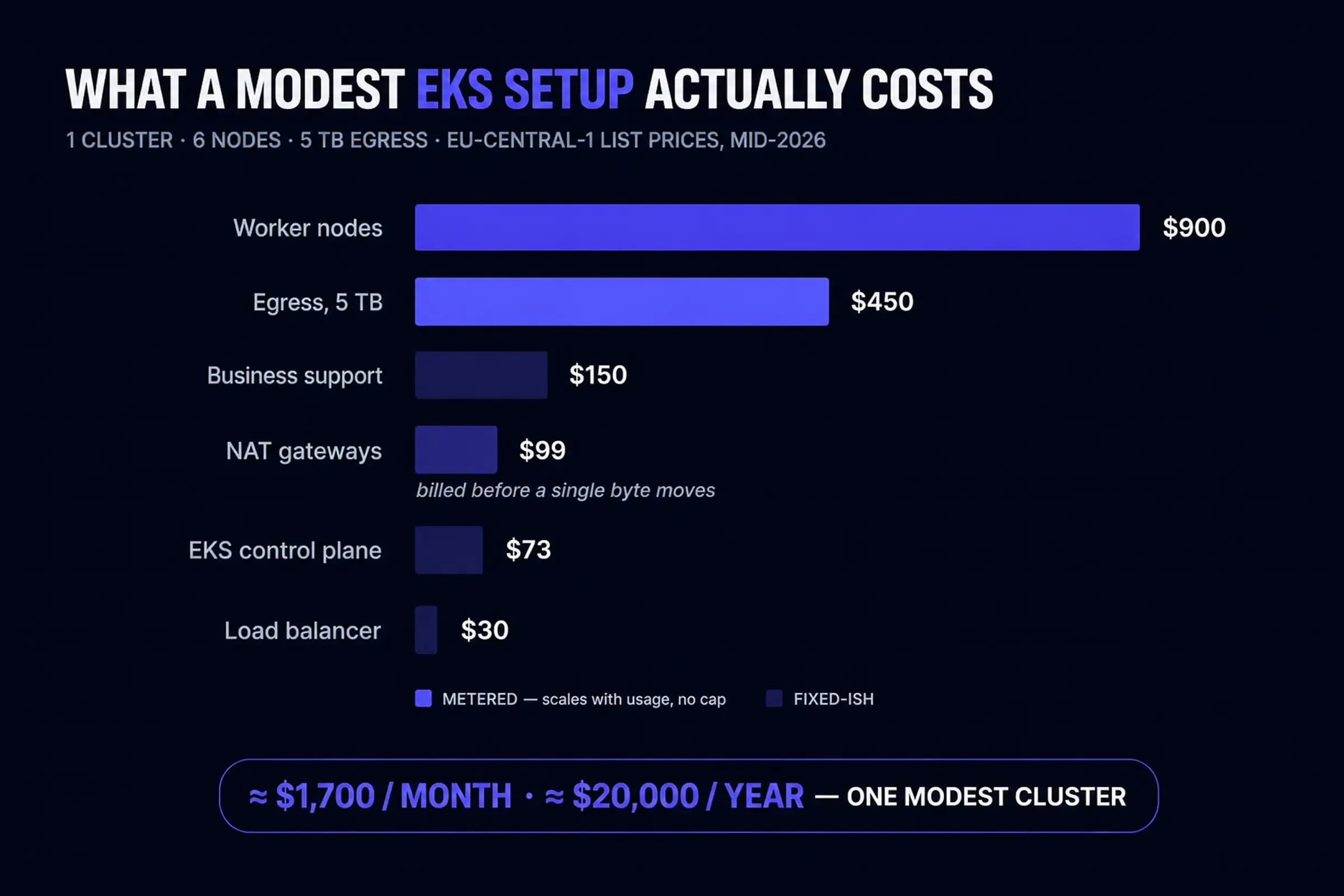
The EKS price everyone quotes is $0.10 per hour — about 73 dollars a month per cluster. It is also the cheapest line on the bill. The expensive lines are the ones nobody planned: NAT gateways that cost money before a single byte moves, egress at an effective $0.135 per GB, load balancers, and a support tier calculated as a percentage of everything else. Add the question of whose law governs your user data, and "EKS is cheap" deserves a closer look.
This article does two things: shows the real math of a typical mid-market EKS setup, and explains what a dedicated Kubernetes cluster in Germany changes — in euros and in jurisdiction. And, honestly, when EKS remains the right choice.
What EKS actually costs: the bill nobody budgets
List prices, eu-central-1, on-demand, as of mid-2026. A modest production setup — one cluster, six 4-vCPU/16-GB worker nodes across three availability zones, one load balancer, 5 TB of monthly egress:
EKS control plane: $73/month
6 worker nodes (on-demand): ~$900/month
3 NAT gateways (one per AZ): ~$99/month + $0.045/GB processed
Application Load Balancer: ~$30/month
Egress, 5 TB: ~$450/month (plus NAT processing on private subnets)
Business support (10%): ~$150/month
---
TOTAL: ~$1,700/month ≈ $20,000/year — for one modest cluster
Three properties of this bill matter more than the total. First, it scales with usage in ways you cannot cap: every GB out, every NAT-processed byte, every additional cluster ($73 each) moves it. Second, half the lines exist only because of the hyperscaler architecture — NAT gateways and cross-AZ traffic are solutions to problems dedicated infrastructure does not have. Third, staging and dev multiply everything: three environments is three control planes and often three sets of NAT gateways.
None of this is hidden. It is all on the pricing page — spread across five of them. The pattern is the same one we documented for S3 egress: the platform is cheap to enter and expensive to use.
The jurisdiction question GDPR audits actually ask
The Frankfurt region keeps your data in Germany geographically. Legally, AWS remains a US company, and the US CLOUD Act obliges US providers to produce data on lawful request — regardless of where the data physically sits. For many businesses that residual risk is acceptable and documented. For companies in KRITIS scope, DiGA/healthcare, or under a strict works-council or customer requirement, "the region is in Frankfurt" is regularly the answer that fails the audit question.
AWS itself acknowledges the gap — that is what the European Sovereign Cloud initiative is for. Whether a hyperscaler-operated sovereign offering satisfies your auditors is a question worth asking them before you architect around it. A dedicated cluster operated by a German company under German law answers it structurally: there is no US parent in the chain of control.
What are you actually using EKS for?
An honest inventory question. EKS earns its keep when you use the ecosystem deeply: IAM-integrated service accounts, Karpenter-driven burst scaling, Lambda and SQS wired into workloads, multi-region failover. If that is you, the premium buys real capability.
Most mid-market estates we audit use a fraction of it: a cluster, an ingress, a container registry, Prometheus, and a CI/CD pipeline pushing images. Vanilla Kubernetes — which runs identically on dedicated hardware, minus the metered lines and plus a fixed invoice.
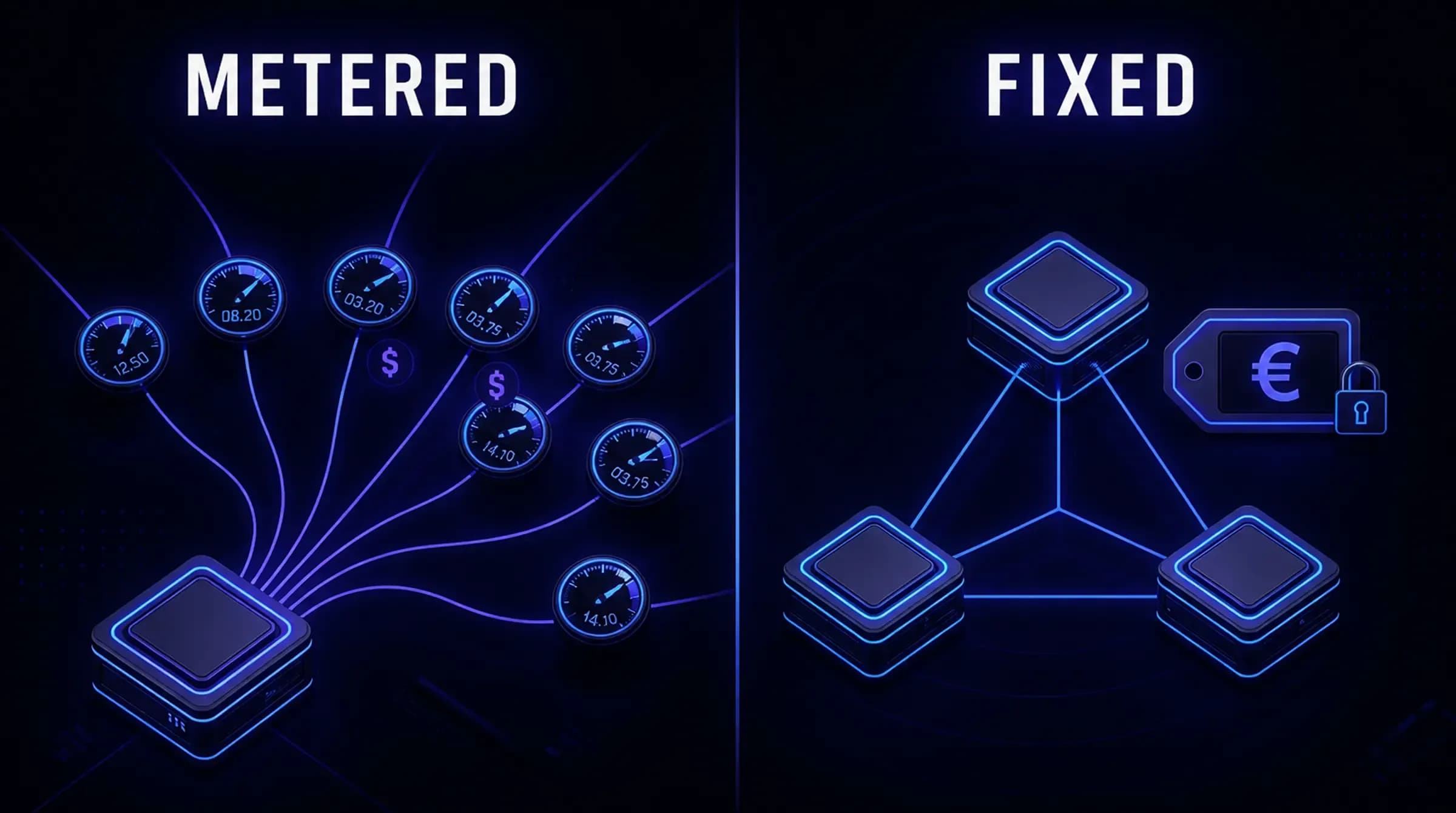
The alternative: a dedicated cluster in Germany, fixed price
Dedicated Kubernetes in our Frankfurt data center: isolated VLANs, optionally hardware reserved exclusively for you, vanilla Kubernetes on open standards. Three operating models, all net, all fixed monthly:
- KubeCore Root (self-managed): dedicated three-node cluster with full root access — from 100 €/month, priced by resources.
- Smart Managed: we handle updates, monitoring and best practices — from 199 €/month for a three-node cluster.
- Enterprise Managed 24/7: SLA, incident response, backups, operational ownership — priced individually, currently from 350 € net/month.
No egress metering, no NAT gateways, no per-cluster fee, no support percentage. The trade, stated honestly: you give up minute-level elastic burst scaling (hardware scales in days, not minutes) and the deep AWS service integrations. What you get is a fixed number your CFO can plan with, and a platform you can take anywhere — the full comparison is on our Managed Kubernetes page.
How the migration works
Vanilla Kubernetes on both sides makes this a planned move, not a rewrite: manifests, Helm charts and registries move as-is. Workloads migrate namespace by namespace with EKS as fallback; DNS cutover per service; the EKS bill ends when the last namespace is validated. For estates using AWS-specific glue (IAM roles for service accounts, ALB ingress annotations, EBS storage classes), the assessment maps each dependency to its open-source equivalent before anything moves. Typical calendar time for a mid-market estate: two to four weeks, staged.
When staying on EKS is the right call
We are not here to talk you off a platform that fits. Stay if:
- Your workloads genuinely burst — batch jobs or traffic spikes that need hundreds of cores for hours, then nothing. Elastic capacity is what hyperscalers are for.
- You are deeply invested in the AWS ecosystem — IAM, Lambda, SQS, DynamoDB wired into the platform. Unwinding that costs more than the bill.
- Your compliance requirements are satisfied by AWS attestations and your auditors accept them. Then jurisdiction is not your problem to solve.
The math flips when the bill is dominated by steady-state workloads paying elastic prices, when egress becomes a line item your CFO asks about, or when an audit makes data jurisdiction a hard requirement.
Frequently Asked Questions
How much does EKS really cost per month?
The control plane is $73/month per cluster, but a realistic modest production setup — nodes, NAT, load balancer, egress, support — lands around $1,700/month. The total depends heavily on egress volume and environment count.
Is EKS GDPR-compliant?
AWS provides the standard contractual framework, and many DPOs accept it. The unresolved point is the US CLOUD Act: as a US provider, AWS can be compelled to produce data regardless of region. Whether that residual risk passes your audit depends on your industry and auditors.
Can we move off EKS without rewriting our applications?
If your workloads are standard Kubernetes — deployments, ingresses, Helm charts — yes: they run unchanged on any conformant cluster. AWS-specific integrations (IAM service accounts, ALB annotations) need mapping to open-source equivalents; that is assessment work, not rewrite work.
What does a dedicated cluster in Germany cost?
From 100 €/month self-managed and from 199 €/month managed for a three-node cluster, priced by resources — fixed monthly, no egress metering. A fixed quote takes one assessment call.
Is a dedicated cluster as reliable as EKS?
With three nodes across isolated infrastructure, HA and monitored operations, you get a 99.9% SLA in the Enterprise model. What you do not get is AWS-scale elasticity — that is the honest trade.
Have questions about this topic?
Our experts are happy to advise you on your individual strategy.
Schedule a consultation