
$87,735 for a server you never own: what three years of bare metal really cost in Germany, from the cloud to the office server room to colocation
$87,735 for AWS bare metal vs €45,144 for your own server in a Frankfurt rack: what one server costs over three years in Germany, and when not to move.
Three years of an m6i.metal in AWS Frankfurt, 64 cores and 512 GB RAM, cost $87,735.78 with a three-year reservation and no upfront payment. At the end of the term you own nothing. A server of the same class from a German integrator's public configurator lists at €36,175 net; three years in a Frankfurt colocation rack, power and setup included, add €8,969. Total: €45,144, and the hardware is yours. All figures come from public price lists, and none of them is the whole story. This article walks through what one server actually costs in Germany over three years: at a hyperscaler, at a mass-market dedicated host, in the office server room and in colocation in Frankfurt, and where each model stops making sense.
What happened: the cloud premium is largest exactly where the workload is steadiest
Cloud pricing is built for load that changes. Bare metal is the opposite case: a 64-core box that runs a database, a Proxmox cluster node or a Ceph OSD host is busy around the clock, for years. That is where the hourly meter hurts most. The numbers below are for one server drawing a constant 0.5 kW; multiply by your node count.
Option                                    Calculation                          3 years
-----------------------------------------------------------------------------------------
AWS m6i.metal, Frankfurt, on demand       $7.36/h x 730 h x 36 months          $193,420.80
AWS m6i.metal, 3-yr reserved, no upfront  $3.3385/h x 730 h x 36 months        $87,735.78
Own server: 64-core EPYC, 512 GB DDR5,
  2 x 3.84 TB NVMe, list price, net       one-off                              EUR 36,175
Colocation 2U, 100 kWh incl., Frankfurt   (EUR 139 + 265 kWh x EUR 0.40) x 36
                                          + EUR 149 setup                      EUR 8,969
Own server in colocation, 3 years         EUR 36,175 + EUR 8,969               EUR 45,144

Sources: AWS eu-central-1 price list, Linux, 09.09.2026. Thomas-Krenn configurator,
09.09.2026. Colocation: Hostzero price list, October 2026.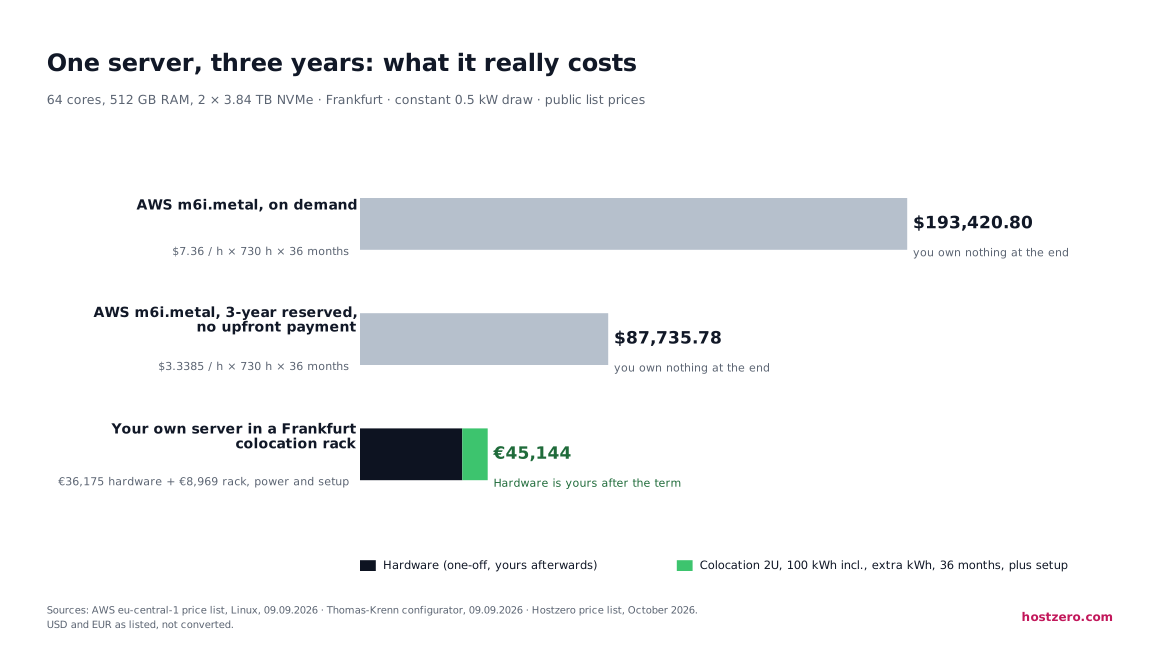
Read the table as two commitments, not two prices. On demand is what you pay while you have not decided yet; $5,372.80 a month is the cost of optionality. The reservation is what you pay once you commit to three years, and buying a server is exactly that commitment, made once instead of monthly. Per month, the reserved instance is $2,437.11; the owned server in the rack works out to €1,254 over the same 36 months, colocation, power and setup included. We leave the dollars in dollars on purpose. The exchange rate is yours to apply, and it will not close a gap of that size.
What the table leaves out, in the cloud's favour
- AWS replaces a failed host without asking you. With your own server, warranty length and who handles the RMA are contract questions, not footnotes. Ask before you buy.
- AWS bills nothing upfront. Owning means €36,175 leaves your account in month one.
- The list price excludes VAT and delivery. The reserved instance excludes storage and egress; the owned server has 7.68 TB of NVMe inside the €36,175, and the rack includes 20 TB of traffic a month.
- Provisioning is minutes at AWS and days to weeks for planned, racked, tested hardware. If you need the capacity on Thursday, the meter wins.
- The power assumption matters. At a constant 0.5 kW the server uses 365 kWh a month; a box that averages 0.3 kW uses 219 kWh and the rack costs €187 a month instead of €245. Measure at the PDU before you compare.
- After three years the cloud bill continues at the same rate. The owned server keeps running for €2,940 a year in rack, power and uplink, but it is also three years older, and at some point you refresh it. That is a real cost; it is just not a monthly one.
The office server room: the €753 that hides the rest
The other starting point is not the cloud but the closet next to the meeting room. On paper it is the cheapest option of all. One 0.5 kW server draws 4,380 kWh a year; at the current German business tariff of 17.2 ct/kWh (BDEW electricity price analysis, August 2026, small and medium-sized enterprises) that is €753 a year. The same server in a Frankfurt colocation rack costs €2,940 a year: 2U, 100 kWh a month included, the rest at €0.40 per kWh, uplink with 20 TB of traffic included.
The difference is €2,187 a year, or €182 a month. That buys redundant A/B power, UPS and generator, cooling, fire suppression, access control with a log, engineers on site, a 1 Gbit/s uplink with DDoS protection and the ISO 27001 documentation your auditor asks for. The office number, meanwhile, has not yet paid for the air conditioning that must remove the same 0.5 kW as heat, the UPS batteries nobody replaces on schedule, the square metres the room occupies, a business internet line, a fire concept or a door that records who opened it. Add those honestly and the office is rarely cheaper; it is simply billed to other cost centres.
Two things speak for the office all the same. Latency to your LAN is zero and there is no VPN or cross-connect to plan; a print server or a file share for twelve people does not need a Tier III+ data center. And moving a server that is already six years old costs planning time the hardware may not deserve; in that case the question is not colocation versus office, it is replace versus keep. If the box in the closet is one you do not depend on, leave it there. If it runs your ERP, your Proxmox cluster or your customers' data, €182 a month is what it costs to stop being your own data center operator. What the rack in Frankfurt includes is on our data center page.
Four cost models side by side
Criterion | Hyperscaler bare metal | Mass-market dedicated host | Office server room | Colocation in Frankfurt |
Billing | Per hour, plus storage and egress per GB | Fixed monthly rent per catalogue server | Electricity, rent, cooling, spread over cost centres | Fixed monthly price per rack unit with 100 kWh included, extra kWh metered; hardware one-off |
Hardware ownership | None | None, returned on cancellation | Yours | Yours, bring it or buy it through partners |
Upfront capital | None | None | Full purchase price | Full purchase price |
Contract term | None, or 1 to 3 years reserved | Usually monthly | None | 12 months, or monthly from 3 months |
Provisioning | Minutes | Minutes to hours | Delivery time plus your own installation | Days to weeks: planned, racked, tested |
Sizing | Full-host instances only (m6i.metal = 64 cores / 512 GB) | Fixed catalogue configurations | Anything you order | Exactly what you specify, from one server to a cluster |
Operations | You, or paid support tiers | You | You, including power, cooling and access | You, or managed operations on top |
Connection to your sites | VPN or Direct Connect, at extra cost | Public internet; VPN is your job | Already on the LAN | VPN, dedicated line or cross-connect, planned with the provider |
Data jurisdiction | US CLOUD Act applies to the provider | Depends on the provider | German | German company, German data center |
Best for | Elastic load, managed services, global footprint | One box today, price first | Small, non-critical, no compliance | Steady 24/7 load you want to own, with everything around it outsourced |
Who actually belongs in colocation
Not every server does, and the pattern is fairly consistent across the companies we talk to. Four signals point to colocation:
- The load is steady. Utilisation above roughly two thirds around the clock means you are paying the cloud premium for elasticity you never use. Database nodes, virtualisation hosts and storage clusters are the typical cases.
- You already own hardware younger than three years. Rack space from €79 a month is the cheapest way to keep using it; the alternative is writing it off and renting it again.
- The servers are the foundation of a private cloud. Proxmox, Kubernetes and Ceph want fixed hosts with local NVMe and predictable network; the hourly meter adds cost without adding anything the platform can use.
- You have to prove things. German jurisdiction with no third-country transfer, an ISO 27001 data center, an access log and documented operations turn the supply-chain part of a NIS2 risk assessment from a discussion into an attachment.
Eight questions before you sign a colocation contract
Colocation offers look alike on the first page and differ on the third. These are the questions that decide the actual price:
- Power: is it billed per kW or per kWh, how much is included, what does the rest cost, and is it measured or estimated? Measure your real draw at the PDU before you sign; nameplate values are usually far above it.
- Space: which rack depth, which rails, are PDUs and cabling included, and can you grow from 2U to 4U in the same rack without a new contract?
- Uplink: what speed, how much traffic or which fair-use rule, IPv4 and IPv6, DDoS protection, and can you bring your own address space or AS if you need to?
- Connection to your sites: site-to-site VPN, dedicated line or cross-connect to a carrier in the same building, and the lead time for each.
- Remote hands and access: what is included in the monthly price, what is the response time, who may enter the rack, and what does an hour cost when it is not included?
- Hardware: how old is it, how long does the warranty run, who handles a replacement, and if the provider sources the hardware, who owns it at the end?
- Compliance evidence: which certificates does the data center hold (ISO 27001, ISAE 3402, PCI DSS), can you get the access logs, and who are the subcontractors?
- Term and exit: what is the minimum term and notice period, who de-racks your hardware, and how do you get it back, in days or in a dispute?
When to stay where you are
The honest answer for a good share of readers is: do not move. Stay at the hyperscaler if your architecture lives on autoscaling and managed services, such as managed databases, queues and object storage with lifecycle rules, or if your load swings by a factor of ten between night and Black Friday. You are paying for elasticity and you are using it. Stay at the mass-market dedicated host if you need one box today by credit card and the monthly price per server is the only criterion; a rented catalogue server is cheaper per month than a turnkey setup, and any colocation provider who tells you otherwise is not showing you the math. Stay in the office if the server is one nobody would notice for a day.
Move when the load is steady, the hardware is worth owning, the platform on top is Proxmox, Kubernetes or Ceph, or an auditor is involved. Then the €45,144 buys something the $87,735 never will: a server that is still yours in year four.
What we do
Hostzero has run infrastructure in Frankfurt for 14 years, the last 10 of them at Telehouse, operated as Tier III+, with our own Juniper routing and our own network, AS201251, on two 10G upstreams. Our VPS, Proxmox, Kubernetes and Ceph hosts stand in the same racks. Managed Bare-Metal Colocation in Frankfurt puts your hardware in a 4-post rack, 1,000 mm deep: from 1U at €79 a month, 2U at €139 with 100 kWh of power and 20 TB of traffic on a 1 Gbit/s port included, DDoS protection included, €0.40 per kWh above that, setup €149. The term is 12 months, or monthly from three months for €20 more. If you have no hardware yet, we size and source it through our integrator partners, deliver it racked, cabled and burned in, and quote it per project together with the colocation on one invoice. Managed Colocation adds monitoring, patching, backups and 24/7 on-call, priced on request; a private cloud on Managed Proxmox or Managed Kubernetes with a Ceph storage cluster sits on top when you want it. And if a single machine is all you need, a Sovereign VPS is the smaller step; we will tell you so in the first call. All prices net, as of October 2026.
Frequently asked questions
What does colocation cost in Germany?
Providers price by rack unit, by kW or by kWh, and the power model decides the real cost. At Hostzero, rack space starts at €79 a month for 1U; 2U costs €139, 3U €169 and 4U €199, each further unit €30, with 100 kWh a month included from 2U, above that €0.40 per kWh, plus a one-time setup of €149. Compare offers at your real draw, not per unit; the full list is on the colocation packages page.
What is the difference between colocation and a dedicated server?
With a dedicated server you rent the hardware and it never becomes yours; the provider chooses the configuration and you operate it. With colocation the hardware is yours, brought along or bought, and you rent rack space, power and uplink around it. Dedicated is faster and cheaper per month for a single box; colocation is cheaper over years for steady load and is the only model in which you own what you run.
Do I have to buy the hardware myself?
No. Bring your own after a compatibility check, or have it sized and sourced through integrator partners and delivered racked and tested. Either way the server is yours and appears on one invoice with the colocation.
How long does a move take?
After the initial consultation and hardware check, usually two to four weeks, faster when rack space is free and the setup is standard. For hardware sourced via partners, add the delivery time of the configuration.
Does colocation in Frankfurt help with GDPR and NIS2?
It keeps the data in a German data center under German law with a German provider: no third-country transfer to explain. An ISO 27001 data center and documented operations make the supply-chain part of NIS2 risk management easier to evidence; NIS2 has applied in Germany since the NIS-2-Umsetzungsgesetz entered into force on 6 December 2025. Your own obligations, such as registration, incident reporting and risk management, remain yours.
What happens after the three years?
The server keeps running, and the only recurring cost is the rack: €2,940 a year for 2U at a constant 0.5 kW draw, less if the server draws less. Most companies refresh hardware in a four- to five-year rhythm; until then every additional month is the cheapest compute you will own.
Have questions about this topic?
Our experts are happy to advise you on your individual strategy.
Schedule a consultation